App review
DramaBox Review (2026): Real Prices Verified — Free Episodes, Coin Math & the $19.99-a-Week Membership
Published
DramaBox holds a 4.8 rating from 857,000 reviews on the App Store, sits in the top 25 of the Entertainment chart, and was the only major short-drama platform to turn a profit in 2024. It is also the platform whose one-star reviews read like a small-claims docket: subscriptions that cost more than people thought they agreed to, coins that vanished while the app autoplayed into a paywall, charges that continued after cancellation. Both are true, and the gap comes down to pricing that is hard to see before you pay.
So this review is a receipt check. I went through DramaBox's official store listings, its web player, and its own support answers in September 2026 to pin down three numbers: how much you can watch free, what finishing a show costs in coins, and what the subscription actually charges. That last number took the most digging, because the one place DramaBox publishes it is a checkout window on its own website that most of its users will never open.
What DramaBox Is
DramaBox launched in 2023, operated by Singapore-registered StoryMatrix, the international arm of Beijing's Dianzhong Technology. By its own count the catalog passed 2,000 series in late 2024, most of them Chinese dramas dubbed or remade for Western audiences, plus a slate of English originals shot at its Los Angeles studio. One of those originals is Divorced at the Wedding Day, whose 2024 Chinese twin is still on the same app.
The business is unusually healthy for this industry. Media Partners Asia put DramaBox at $323 million in 2024 consumer spending with a $10 million net profit, which made it the only major platform in the black that year; ReelShort took in more (about $400 million) and still lost money on marketing. In 2025 Disney picked DramaBox as one of four companies for its accelerator program, and in April 2026 The Trade Desk became its first programmatic ad partner. Sensor Tower's Q1 2026 data has DramaBox and ReelShort each pulling in about $140 million in quarterly in-app purchases, together roughly 70% of everything the genre earns worldwide.
The two giants do not get along. In July 2025, Dianzhong publicly accused ReelShort's parent Crazy Maple Studio of copying its shows, flagged eight titles, and got three taken down. If you watch enough of both apps you will eventually spot the same premise wearing two different casts, and now you know why.
The Free Path, Checked
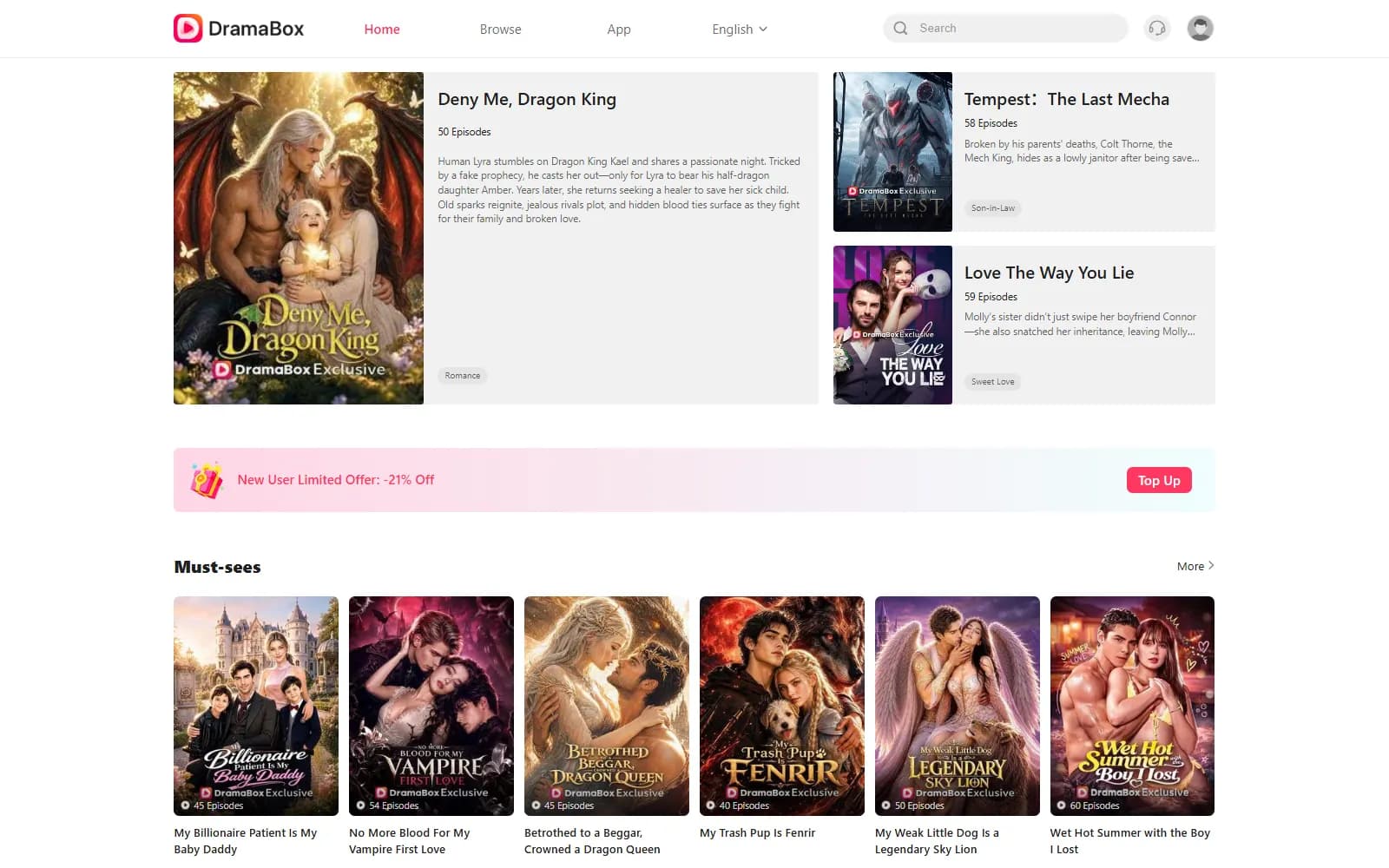
DramaBox does not publish a free-episode policy anywhere I could find. The official site shows no pricing, no coin amounts, and no lock markers on its drama pages, just a "Play Now" button and a prompt to open the app.
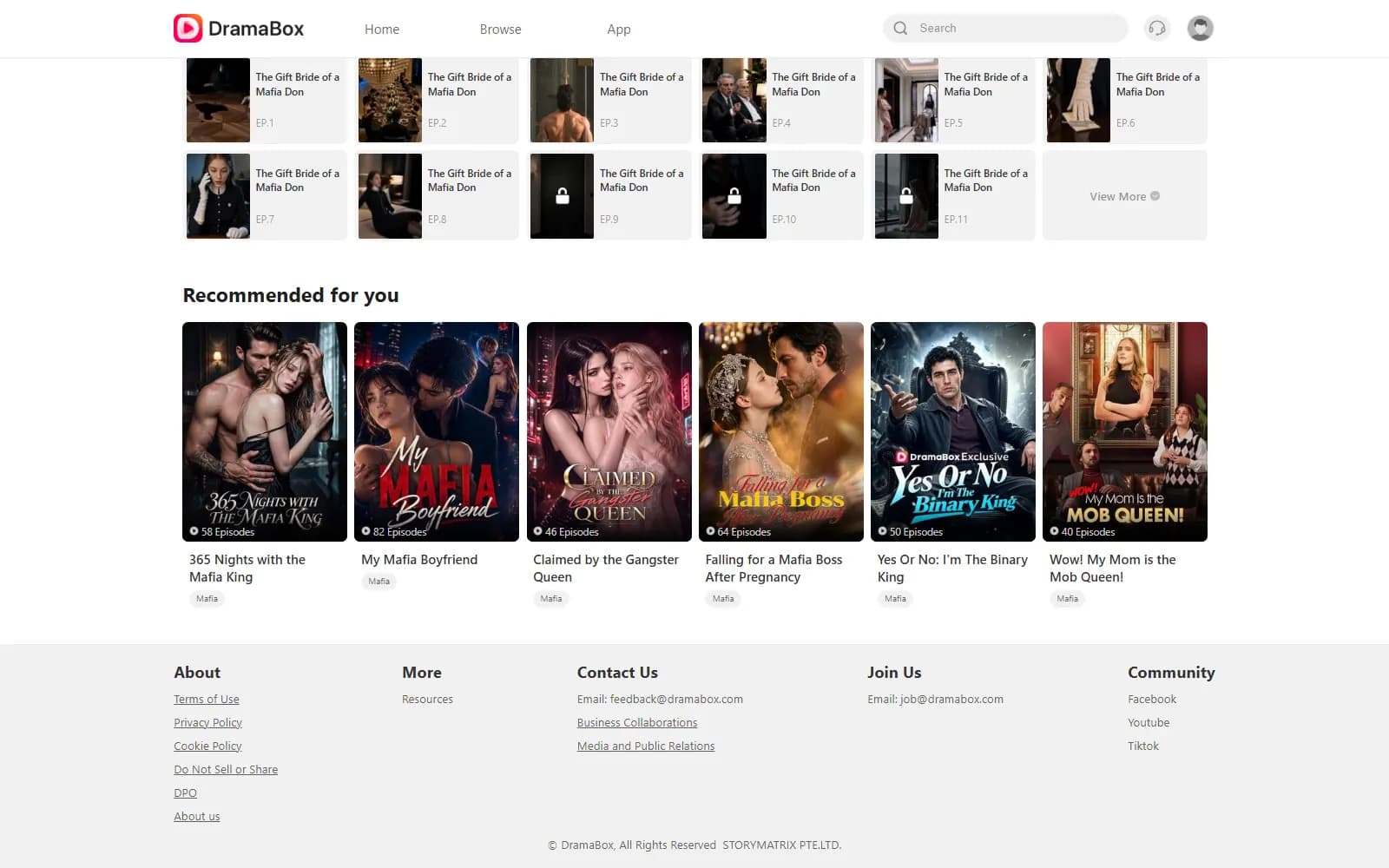
Free windows are set per show, the same way ReelShort does it. Divorced at the Wedding Day opens 18 of its 51 episodes free, confirmed against the lock icons in the web player. The Gift Bride of a Mafia Don, a 60-episode title from the mafia catalog, gates from episode 9. The only way to know a show's free window is to open it and scroll the episode list for the first lock.
Past the free window, DramaBox's own support responses lay out two routes, and I'm quoting the company here: "You can unlock dramas for free by collecting free coins through completing tasks or simply by watching ads." In practice that means a daily check-in plus rewarded ads, which user guides consistently cap at around 15 ads per day at 2 coins each. Locked episodes run 2 to 9 coins, with 5 the commonly reported middle. Do the arithmetic and a full day of ad-watching buys roughly 6 episodes, or about 9 minutes of video, earned across 30-second ads with cooldowns between them.
That's a real path, and for one show at a time it works. It is also slow enough that the paywall does its job.
What Finishing a Show Costs
Take a typical locked title: 60 to 80 episodes, free window somewhere between 8 and 18, the rest at around 5 coins each. That leaves 250 to 350 coins of locked content per show. Coin pack prices vary by market and promotion, but user reports on finishing a single series cluster between $30 and $50. For comparison, that is a month of every major streaming service at once, spent on ninety minutes of one vertical drama.
Two mechanics make the number easy to hit by accident. First, autoplay: the app rolls from episode to episode, and when it crosses into locked territory it can spend your coin balance without a confirmation step. App Store reviewers describe drained balances often enough that disabling autoplay should be your first move after installing. Second, expiring coins: purchased and bonus coins carry time limits, so a balance you banked for next month may not be there.
None of this is hidden so much as never stated, and the subscription takes that pattern to its logical end.
The Subscription, Finally Priced
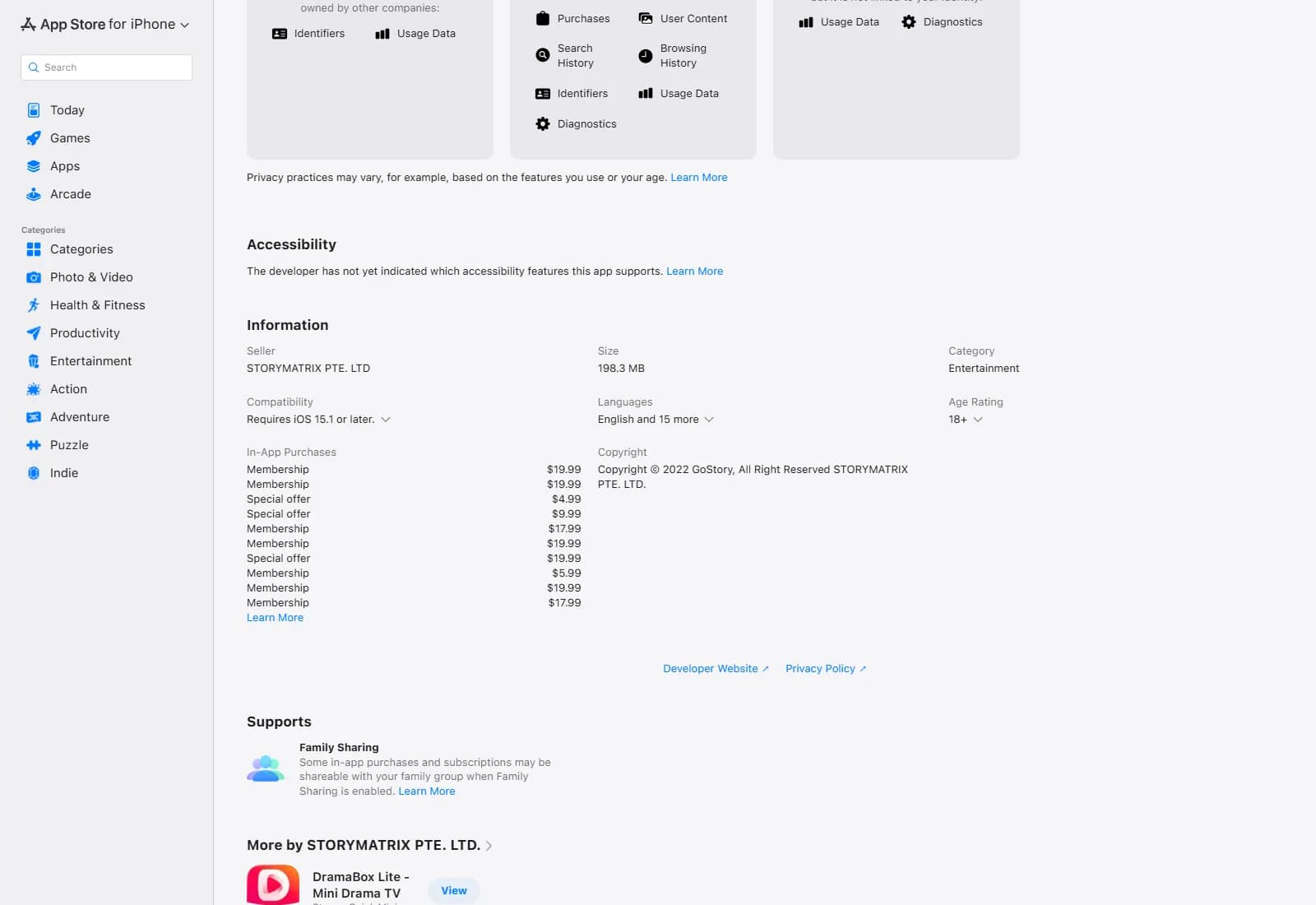
Here is DramaBox's complete in-app purchase list as the App Store discloses it, verbatim, September 2026:
| Listed name | Price |
|---|---|
| Membership | $5.99 |
| Membership | $17.99 |
| Membership | $17.99 |
| Membership | $19.99 |
| Membership | $19.99 |
| Membership | $19.99 |
| Membership | $19.99 |
| Special offer | $4.99 |
| Special offer | $9.99 |
| Special offer | $19.99 |
Ten products, and not one names a duration. You cannot tell from this page whether $19.99 buys a week, a month, or a year, and third-party review sites disagree on exactly this point, quoting annual plans at $49.99 or $79.99. As far as I can tell those figures are all wrong. The company publishes its real price sheet in one place: the top-up window on its own website, shown to any visitor, no account needed.
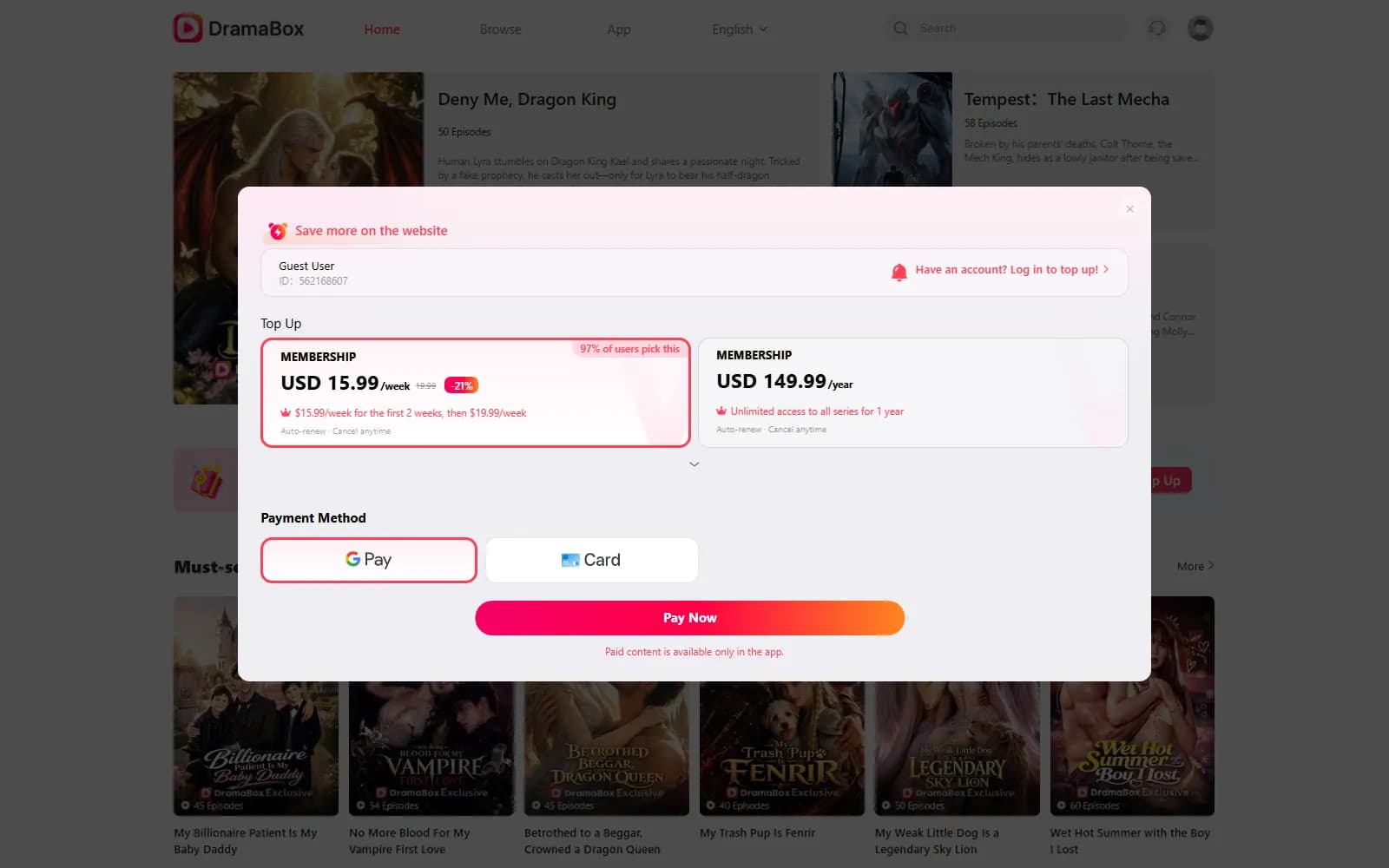
The standard membership is $19.99 a week, discounted to $15.99 for the first two weeks, auto-renewing. The alternative is $149.99 a year for unlimited access. Run both out over a year and the weekly plan costs $1,039; the annual costs $150. That is a seven-fold gap between two ways of buying the same catalog, and the badge reading "97% of users pick this" sits on the expensive one.
The weekly price also explains the angriest reviews. $19.99 reads like every monthly streaming subscription you've ever had, the app's own purchase screen doesn't fight that assumption, and by the time the second renewal lands you've paid $56 for three weeks. Reviewers who describe DramaBox costing more than Netflix, Hulu and Disney+ combined aren't exaggerating; at weekly rates that's just true. Two smaller flags from the same window: "Paid content is available only in the app" means web membership is a checkout, not a player, and "Save more on the website" means in-app prices run higher still, since Apple and Google take their cut. Meanwhile the App Store description promises "ad-free streaming and uninterrupted viewing" on a listing Apple labels "Contains Advertising."
Before you confirm any DramaBox purchase, read the payment sheet Apple or Google shows you, because that dialog states the real renewal period even when the app's screen is ambiguous. If you actually watch daily, the $149.99 annual is the only plan whose math works. And when you cancel, do it in your phone's subscription settings rather than inside the app; reviewers who report post-cancellation charges generally turn out to have cancelled somewhere that wasn't the store subscription page.
Is DramaBox Worth It?
The catalog is the biggest in the genre and the production floor on its originals keeps rising. As a free app, sampled one show at a time on ad coins and web free windows, it's a fair deal and the 4.8 rating makes sense. My mafia roundup and billionaire roundup both lean on DramaBox titles because the shows earn their spots.
As a paid service, the only plan whose math survives inspection is the $149.99 annual, and only for someone watching most days. If you're deciding between the two giants, ReelShort publishes its free windows and episode counts on public web pages where anyone can check them before installing, while DramaBox keeps its real price sheet in a checkout window and its store listing says "Membership" ten times without a duration. The shows are comparable; the transparency isn't.
DramaBox's subreddit shows where the paywall pushes people. It is, functionally, a board where strangers beg each other for pirated copies of shows they started free and couldn't afford to finish. I won't link any of it, and most of those files are exactly the malware bait they look like. If a show has you hooked at its paywall, the 30 ad-coins a day are the legitimate version of the same impulse, and they cost you nine minutes of ads instead of your card number.